
Nepal's Rastriya Swatantra Party is surging ahead in the general elections after Gen Z protests ousted the previous government, signaling a potential new era in Nepali politics.

Former Nepal Prime Minister K.P. Sharma Oli has been arrested in connection with the deaths during the Gen Z protests last year, following the implementation of a probe commission's report.

Former Nepalese Prime Minister K P Sharma Oli and ex-Home Minister Ramesh Lekhak have been released on personal recognisance bail after being arrested in connection with the Gen Z protests of September 2023.

Rapper-turned-politician Balendra Shah's Rastriya Swatantra Party (RSP) is on track for a significant victory in Nepal's general elections, potentially reshaping the country's political landscape.

Nepalese citizens are voting in the general election, the first since protests toppled the previous government. Over 18.9 million are eligible to vote for the 275-member House of Representatives.

Rapper-turned-politician Balendra Shah's Rastriya Swatantra Party (RSP) is poised to form the next government in Nepal after a decisive victory in the general election, significantly impacting established political parties.
Nepal's deposed prime minister K P Sharma Oli has denied that his government gave the shootout order during the 'Gen Z' protests on the first day of the agitation on September 8 that killed at least 19 people.

Madhav, the chairman of the Communist Party of Nepal-Unified Socialist, was present in a special court to present his arguments relating to the land misappropriation case.

Former deputy prime minister has jail term extended by three months.
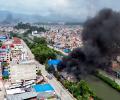
'9 September saw Kathmandu and other key cities under the control of goons.' 'There was no authority, the police was nowhere.' 'The crowds torched all three centres of the state -- the supreme court, parliament and the Singha Durbar government headquarters.' 'The army stayed aloof from the complete destruction of these edifices, which is less than a kilometre from its headquarters.'

The leader of Nepal's largest communist party was appointed as prime minister on Sunday by President Ram Chandra Paudel to lead the coalition government with the Nepali Congress (NC), the largest party in Parliament, apart from other smaller parties.
Nepal political parties on Friday night agreed to extend the term of Constituent Assembly by one year as part of a crucial deal under which Prime Minister Madhav Kumar Nepal agreed to step down.

A day after premier K P Oli resigned, Nepal President called on all the political parties to elect a new prime minister within a week
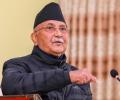
The decision to remove Oli from the party's general membership was taken at the Standing Committee meeting of the faction led by former prime ministers Prachanda and Madhav Kumar Nepal after Oli failed to produce explanation to his recent moves as sought by party leadership, sources said.

The JSP has made an electoral alliance with main opposition Communist Party of Nepal-Unified Marxist Leninist headed by K P Sharma Oli.

'Gyanendra back on the throne would be bad news for the Nepali people. He may not have learnt from his experience, but we have.'

Prachanda took the oath of office and secrecy from President Bhandari at an official ceremony at Shital Niwas.

The exit of CPN-UML may not immediately affect the Prachanda-led government, which is supported by the Nepali Congress which has 89 lawmakers in the House.
Two senior Nepalese leaders, including the chief of the ruling party, on Tuesday left for India, where they are set to meet the Indian leadership, as the political crisis in Nepal deepened with the Maoists stepping up their protests to destabilise the government.
Veteran Communist leader Madhav Kumar Nepal was on Saturday elected unopposed as the prime minister of Nepal, bringing to an end the nearly three-week long political crisis in the country. The 56-year-old Communist Party of Nepal (Unified Marxist Leninist) leader, who claims to have the support of 351 lawmakers in the 601-member Constituent Assembly, was the only candidate to have filed the nomination for the top post. The Maoists boycotted the voting process.
Nepal on Friday sought India's co-operation in moving the peace process forward, giving indications ahead of Foreign Secretary Shivshankar Menon's visit that it was looking forward to closer bilateral ties.
In a major breakthrough, Nepal's ruling coalition partners on Saturday sorted out the vexed issue of portfolio distribution and power sharing after they 'tentatively agreed to a deal' to give the 20-day-old Communist Party of Nepal-Unified Marxist Leninist government a "full shape" by Sunday.

The main Opposition party Communist Party of Nepal-(Unified Marxist-Leninist) (CPN-UML) disrupted the National Assembly meeting on Wednesday, demanding the prime minister's resignation. The meeting has been postponed to 1 pm Thursday.
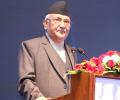
Nepal plunged into a political crisis after President Bidya Devi Bhandari dissolved the House of Representatives and announced dates for mid-term elections at the recommendation of Prime Minister Oli on Sunday, sparking protests from a section of the ruling party and various opposition parties.
Stepping up his anti-India rhetoric, Maoist supremo Prachanda has accused it of backing a 'conspiracy' to restore monarchy in Nepal, which had turned into a republic from a kingdom just a year ago. Prachanda, who quit as premier after a dispute with President Ram Baran Yadav over the issue of sacking of the army chief, said the present Communist Party of Nepal (Unified Marxist Leninist) -led government is 'just a puppet' and efforts are on to 'murder the infant republic'.

A five-member Constitutional Bench of the Supreme Court led by Chief Justice Cholendra Shumsher Rana issued the verdict stating that President Bhandari's decision to dissolve the lower house upon a recommendation of Prime Minister K P Sharma Oli was an unconstitutional act, delivering a major blow to the veteran Communist leader who was preparing for snap polls.
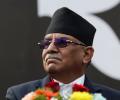
Former Nepalese foreign minister Ramesh Nath Pandey observed that the current situation is not encouraging for India-Nepal ties, saying the "present leaders" created irritants in the relationship in the past.
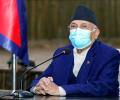
Former Nepalese prime minister KP Sharma Oli claimed that he was removed from power last year after his government published a new map of Nepal that included Kalapani, Limpiyadhura and Lipulekh as its territories.

Maoist chief Prachanda was on Wednesday elected by lawmakers as Nepal's Prime Minister for a second time.
In a dramatic turn of events, Communist Party of Nepal-Maoist Centre chairman Pushpa Kamal Dahal 'Prachanda' was appointed as the new prime minister of Nepal by President Bidya Devi Bhandari on Sunday.

Nepal witnessed political turbulence in 2022 that dramatically turned rivals into allies and throned former guerrilla leader Pushpa Kamal Dahal 'Prachanda' as the prime minister for a third time, as Kathmandu made efforts to balance ties with immediate neighbours India and China with high-profile talks and visits.

Three Madhesi leaders have supported Prachanda's candidacy.
The 75-year-old veteran politician and Nepali Congress President took the oath of office and secrecy from President Bidya Devi Bhandari during a swearing-in ceremony which was delayed by over two hours.

K P Sharma Oli was elected as the next prime minister of Nepal on Sunday defeating incumbent Sushil Koirala in a contest which became necessary after parties failed to forge a consensus amid violent protests over the country's new Constitution.
Nepal's political crisis deepened on Friday as both embattled Prime Minister K P Sharma Oli and the Opposition parties staked a claim for the formation of a new government by submitting letters comprising signatures of lawmakers to President Bidya Devi Bhandari.

President Bidya Devi Bhandari administered the oath of office and secrecy to Oli, 69, at a ceremony at Shital Niwas, after he was reappointed to the post on Thursday night as the Opposition parties failed to secure majority seats in Parliament to form a new government.

Communist leader Vidya Devi Bhandari was on Wednesday elected as Nepal's first woman President by the parliament, weeks after it adopted a new landmark Constitution that declared the country a secular state.

The Shiv Sena on Monday refused to call off the protest against the book launch of former Pakistan Foreign Minister Khurshid Mahmud Kasuri in Mumbai.

For India to endorse Nepal's Buddhist conference will be like sipping from a poisoned chalice, warns former RA&W official Jayadeva Ranade.

Postponing elections could lead to the collapse of the interim election government without an alternative arrangement, reports Shubha Singh
 © 2026 Rediff.com - Advertise with us - Disclaimer - Privacy Policy - Sitemap - Feedback - About us - Terms of use - Grievances